
233400: GRILLE: B
18 EA
233100: DUCT-SA: 8" DIA SA
237 LF
1/8" = 1'-0"92%
Stop guessing duct lengths and fitting counts. AI-powered HVAC estimating software that reads your mechanical drawings, traces every duct run, sizes equipment, and generates professional bids in hours instead of days.
14-day free trial · Cancel anytime
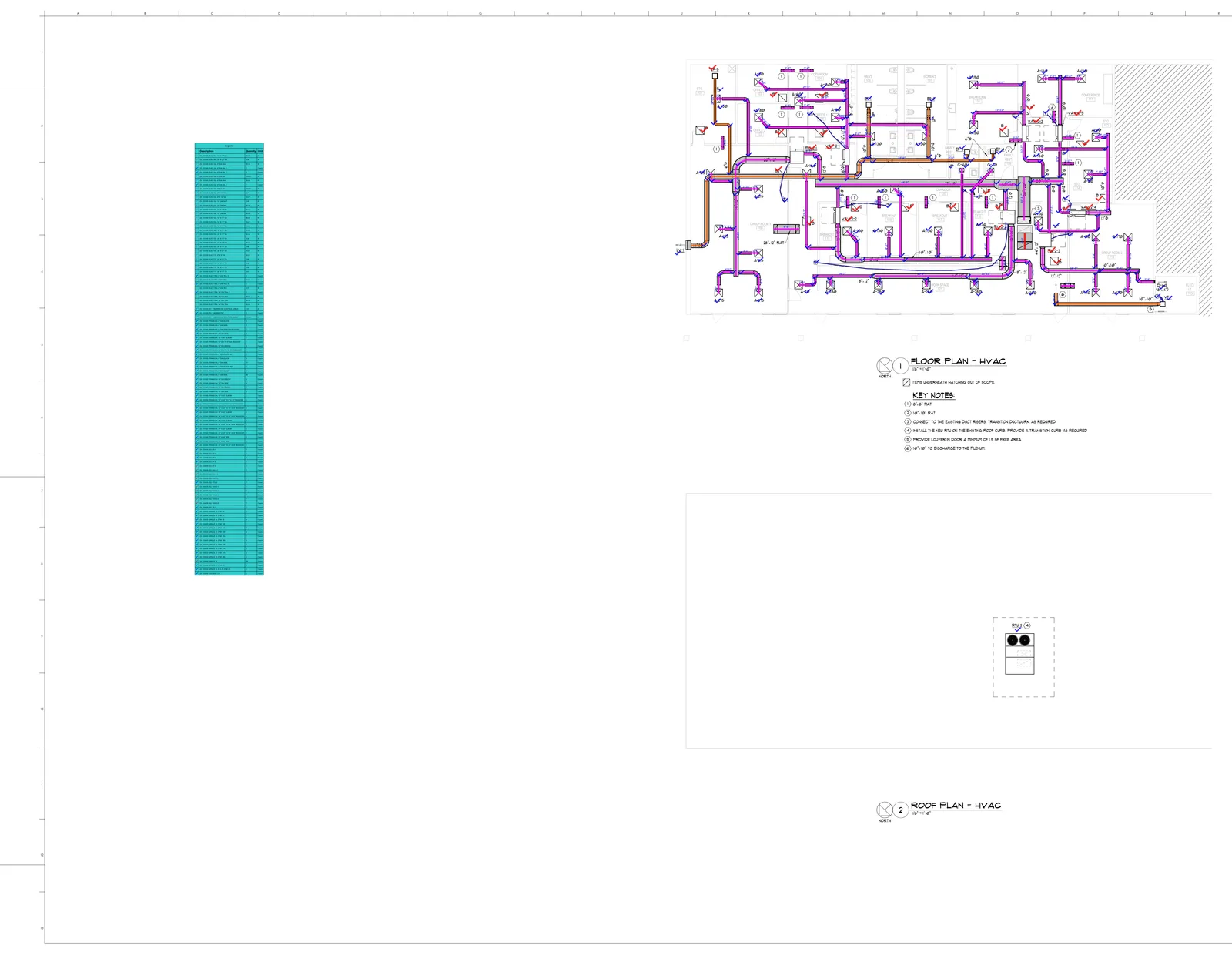
This is the actual BuildVision AI editor on an anonymized commercial M300 floor plan: 334 detected items — supply and return duct runs by size, grilles by CFM, transitions, and thermostats. Click any group or duct run to inspect it.
BuildVision AI turns the duct takeoff above into CSI 23 line items with waste factors, sheet-metal labor hours, and material costs — a bid-ready mechanical estimate.
| CSI | Item | Base qty | Waste | Final qty | Unit | Labor hrs/unit | Material/unit | Line total | Sheet |
|---|---|---|---|---|---|---|---|---|---|
| 233100 | Rtu-2, Roof Top Unit, Manufacturer: Trane, Model: Tsk, Cfm: 5300 | 1 | — | 1 | EA | 34.000 | $10,340.00 | $12,890.00 | M100, M300 |
| 233100 | 8" Dia Round Supply Air Ductwork | 237 | 10% | 261 | LF | 0.176 | $8.02 | $5,547.03 | M300 |
| 233100 | 8" Dia Round Side Ductwork Transition | 34 | — | 34 | EA | 0.328 | $82.00 | $3,624.40 | M300 |
| 233100 | B, 24" X 24" Return Air Grille, Manufacturer: Titus, Model: Model: Par | 18 | — | 18 | EA | 0.580 | $145.00 | $3,393.00 | M300 |
| 233100 | Piu-2-2, Air Terminal, Manufacturer: Trane, Model: Vpe, Cfm: 1470 | 1 | — | 1 | EA | 9.600 | $2,436.00 | $3,156.00 | M100, M300 |
| 233100 | 22" X 18" Rectangular Supply Air Ductwork | 45 | 10% | 50 | LF | 0.521 | $23.66 | $3,134.95 | M300 |
| 233100 | Piu-2-1, Air Terminal, Manufacturer: Trane, Model: Vpe, Cfm: 1380 | 1 | — | 1 | EA | 8.840 | $2,210.00 | $2,873.00 | M100, M300 |
| 233100 | 14" Dia Round Toilet Exhaust Air Ductwork | 64 | 10% | 71 | LF | 0.318 | $14.46 | $2,720.65 | M300 |
| 233100 | 6" Dia Round Supply Air Ductwork | 131 | 10% | 145 | LF | 0.138 | $6.25 | $2,401.56 | M300 |
| 233100 | Vav-2-2, Air Terminal, Manufacturer: Trane, Model: Vce, Cfm: 920 | 1 | — | 1 | EA | 6.784 | $1,696.00 | $2,204.80 | M100, M300 |
| 233100 | 14" X 12" Rectangular Supply Air Ductwork | 44 | 10% | 49 | LF | 0.347 | $15.76 | $2,046.44 | M300 |
| 233100 | A, 24" X 24" Supply Air Grille, Manufacturer: Titus, Model: Omni, Cfm: 280 | 5 | — | 5 | EA | 1.160 | $290.00 | $1,885.00 | M300 |
| 233100 | Piu-2-3, Air Terminal, Manufacturer: Trane, Model: Vpe, Cfm: 740 | 1 | — | 1 | EA | 5.780 | $1,445.00 | $1,878.50 | M100, M300 |
| 233100 | Vav-2-1, Air Terminal, Manufacturer: Trane, Model: Vce, Cfm: 710 | 1 | — | 1 | EA | 5.600 | $1,400.00 | $1,820.00 | M100, M300 |
| + 83 more line items in this division | $45,541.28 | ||||||||
| Division total | $95,116.61 | ||||||||
Line items, quantities, waste factors, and labor hours come from a real anonymized commercial project measured in BuildVision AI. Pricing shown reflects the demo cost catalog — your own price lists and labor rates drive your numbers.
HVAC estimating software is a specialized digital tool designed to help mechanical contractors, HVAC companies, and sheet metal shops calculate the full cost of heating, ventilation, and air conditioning projects. Unlike general construction estimating tools, HVAC estimating software understands the unique complexities of mechanical systems -- from residential furnace and AC installations to commercial rooftop unit replacements, chilled water systems, and full building mechanical fit-outs with variable air volume controls.
At its foundation, HVAC estimating software handles three core tasks. First, it performs ductwork takeoffs: measuring every duct run by size, shape (rectangular, round, oval), and material type, then counting the fittings at every turn, branch, size change, and termination point. A commercial HVAC system on a single floor can involve hundreds of duct sections and fittings, each requiring specific sheet metal gauge, insulation, and labor. Second, it manages equipment takeoffs -- pricing furnaces, condensers, air handlers, rooftop units, fan coil units, thermostats, and controls from manufacturer price lists. Third, it calculates labor hours using industry-standard productivity rates (often SMACNA-based) that account for duct size, material gauge, installation height, and project conditions.
Modern HVAC estimating platforms go beyond basic takeoffs by integrating load calculation data, ensuring that equipment sizing matches actual building loads before you commit to a bid. They also connect to distributor pricing so equipment and material costs reflect current market conditions rather than outdated quotes. The output is a comprehensive bid package that breaks down costs by system -- heating, cooling, ventilation, exhaust, controls -- in the format that general contractors and building owners expect, complete with equipment schedules, scope narratives, and professional formatting that wins work.
A complete HVAC estimate covers these major cost categories. Dedicated software tracks each one automatically.
| Category | Typical Items | Unit | Cost Range |
|---|---|---|---|
| Ductwork | Sheet metal, flex duct, duct board, spiral, fittings, transitions, dampers | Linear ft / Each | $3 - $55/ft |
| Equipment | Furnaces, AC condensers, heat pumps, air handlers, RTUs, boilers | Each | $1,500 - $25,000 |
| Controls & Thermostats | Programmable, smart, building automation, zone controllers, sensors | Each | $25 - $5,000 |
| Refrigerant Piping | Copper lineset, insulation, flare fittings, brazed joints, hangers | Linear ft / Each | $4 - $35/ft |
| Insulation | Duct wrap, duct liner, pipe insulation, mechanical insulation | Linear ft / Sq ft | $0.50 - $8.00 |
| Labor | Sheet metal worker, HVAC technician, pipefitter, apprentice | Per hour | $50 - $140 |
| Permits & Testing | Mechanical permits, duct leakage testing, commissioning, balancing | Per project | $200 - $3,000 |
From mechanical drawing upload to finished bid package in four steps.
Import HVAC plans, equipment schedules, and riser diagrams as PDF files (or a ZIP of PDFs). AI identifies ductwork, equipment symbols, piping, and diffuser locations.
The engine traces duct runs by size and type, counts every fitting (elbows, tees, transitions, dampers), and calculates total linear footage and sheet metal weight.
Apply your own equipment pricing and labor rates for duct fabrication and installation, adjusted for project conditions.
Review the estimate organized by system, apply markup and overhead, and share a branded quote with the customer as a link.
See how HVAC estimating methods compare on the metrics that matter most.
| Criteria | Manual / Paper | Spreadsheet | Dedicated Software |
|---|---|---|---|
| Estimate Speed | 2-5 days | 1-3 days | 4-8 hours |
| Fitting Count | Tally marks | Manual entry | Auto-detected |
| Equipment Sizing | Rule of thumb | Separate tool | Integrated calc |
| Sheet Metal Weight | Estimate | Formula-based | Auto-calculated |
| Price Updates | Quarterly quotes | Manual updates | Saved pricing library |
| Bid Presentation | Typed letter | Basic table | Professional package |
Mechanical estimates involve multi-system coordination and engineering calculations that make accuracy challenging.
HVAC ductwork must be properly sized for airflow (CFM), static pressure, and velocity. Undersized ducts create noise and comfort complaints; oversized ducts waste material and conditioned space.
Manual J load calculations depend on building orientation, insulation levels, window areas, occupancy, and climate zone. Wrong load calculations mean oversized or undersized equipment that costs the contractor callbacks.
HVAC projects often involve heating, cooling, ventilation, exhaust, and controls that must work together. Estimating each system separately and missing coordination points leads to field conflicts.
HVAC equipment prices change with refrigerant regulations, manufacturer availability, and seasonal demand. A condenser unit quoted in January may cost 15% more by the time the project starts in July.
The tools that separate profitable mechanical bids from costly estimating errors.
Automatically measure duct runs from mechanical drawings, counting every fitting, transition, elbow, tee, and damper. Calculate sheet metal weight and fabrication requirements.
Save your own pricing for equipment, ductwork components, piping, insulation, and controls in a custom pricing library.
Save your own labor productivity rates for duct fabrication and installation. Adjust for duct type, gauge, insulation requirements, and working height factors.
Generate detailed mechanical bid packages organized by system (heating, cooling, ventilation, controls). Include equipment schedules, duct sizing, and scope narratives.
How the leading HVAC estimating platforms stack up on key capabilities.
| Software | AI Takeoff | Equipment DB | Load Calc | Bid Generation | Cloud-Based | Price |
|---|---|---|---|---|---|---|
| BuildVision | From $299/mo | |||||
| STACK | $2,999/yr+ | |||||
| FastDUCT | $2,495+ | |||||
| Trimble | $5,000+ | |||||
| QuoteSoft | $3,000+ | |||||
| Wrightsoft | $2,500+ |
HVAC estimating software is a specialized tool that helps mechanical contractors calculate ductwork quantities, equipment costs, labor hours, and total project costs from mechanical drawings. It automates duct takeoffs, fitting counts, and equipment selection to produce accurate bids faster than manual estimating methods.
AI reads mechanical blueprints and identifies duct runs, fittings, equipment locations, and piping routes automatically. It traces ductwork paths, counts every elbow, transition, and damper, and calculates sheet metal requirements -- tasks that take hours to do manually and are prone to missed items.
Yes. Quality HVAC estimating software supports residential systems (split systems, ductless mini-splits, furnaces) through commercial-scale projects (rooftop units, chillers, VAV systems, building automation). Material databases scale from residential flex duct to commercial sheet metal fabrication.
Some HVAC estimating platforms include built-in Manual J load calculations. Others integrate with standalone load calculation tools like Wrightsoft or Elite Software. Either way, accurate load calculations ensure your equipment sizing and ductwork design match the actual building requirements.
The software calculates sheet metal requirements by gauge, dimensions, and type (galvanized, stainless, aluminum). It applies fabrication labor rates for cutting, forming, and assembling duct sections, plus installation labor for hanging, connecting, sealing, and insulating.
Most HVAC estimating platforms accept PDF mechanical drawings, and some also accept CAD files (DWG/DXF) or image files. BuildVision works from PDF plans: upload one PDF or a ZIP of PDFs.
A residential HVAC estimate that takes 3-4 hours manually can be completed in 30-60 minutes. Commercial mechanical estimates that take 2-4 days of manual work can typically be done in 4-8 hours, depending on system complexity and the number of zones.
Leading platforms include energy code reference data and can flag potential compliance issues such as duct insulation requirements, equipment efficiency minimums, and ventilation rates. This helps avoid costly redesigns when plans are submitted for permit review.
Bid more HVAC jobs with faster AI takeoffs from BuildVision. Every missed fitting and underpriced duct run costs you margin.
14-day free trial · Cancel anytime